
Free Online Color Blind Test: How to Interpret Your Results
2026-03-02 · DeficiencyView Team · 9 min read
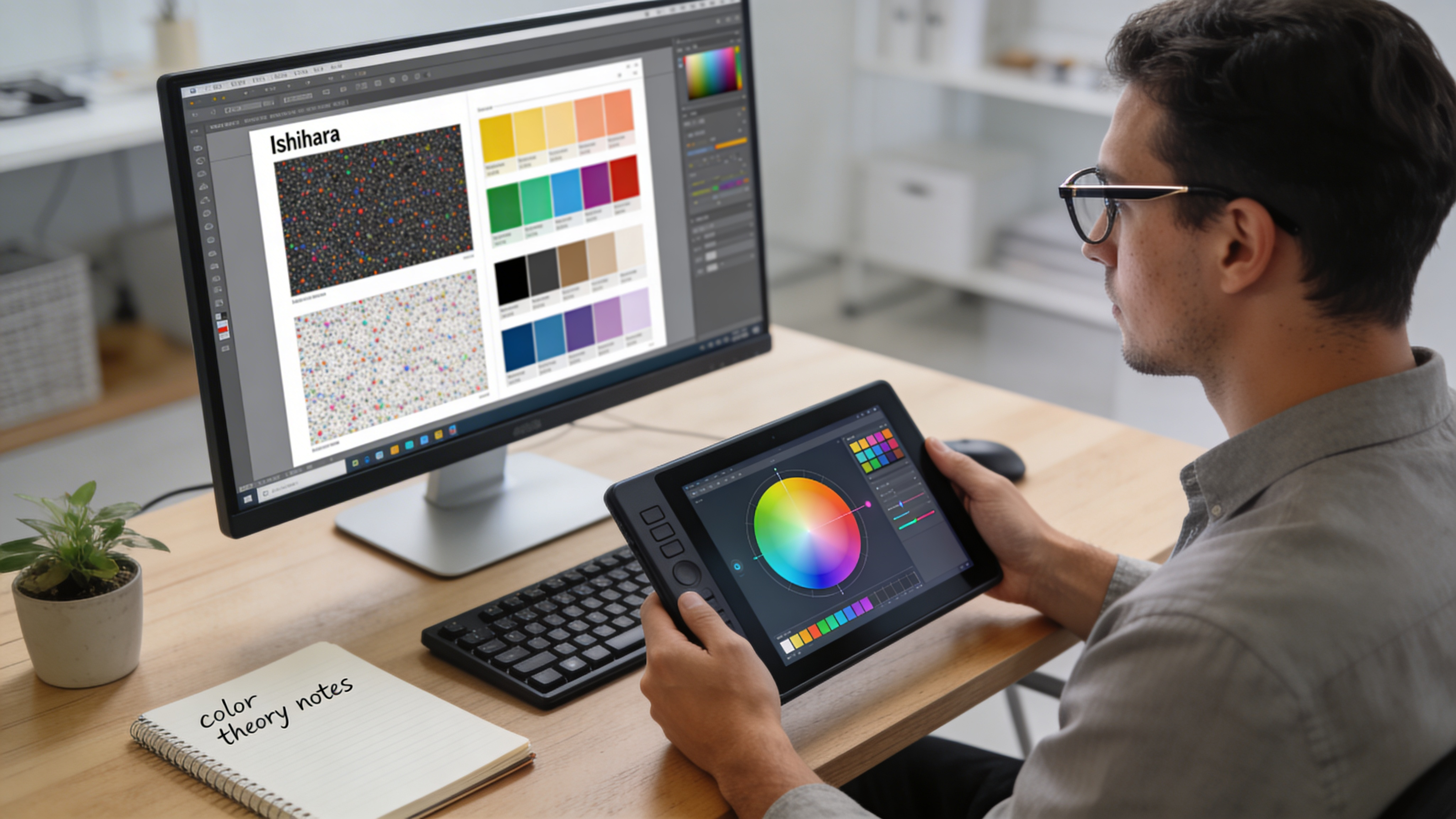
TL;DR: Finished the plates? This guide explains Ishihara results and when to see an eye doctor.
You just took a free color blind test online, and now you’re staring at results that mention terms like “deuteranopia” or “protanomaly.” What does it all mean? More importantly, what should you do next?
Approximately 300 million people worldwide live with some form of color vision deficiency (CVD) that’s roughly 1 in 12 men and 1 in 200 women. If your test suggests you might be among them, understanding your results is the crucial first step toward adapting your daily life, career choices, and creative work.
This guide walks you through everything you need to know about free online color blindness tests: how they work, what your results actually indicate, the limitations of digital screening, and practical next steps. Whether you’re testing yourself out of curiosity, screening for a job requirement, or trying to understand why certain color combinations have always looked “off,” you’ll leave with clear answers.
What Happens During a Free Online Color Blind Test
Most free color blind tests follow the Ishihara test format, developed by Dr. Shinobu Ishihara in 1917. This screening method remains the gold standard for detecting red-green color blindness over a century later.
How Ishihara Plates Work
Ishihara plates consist of colored dots arranged in circular patterns. Hidden within these dots are numbers, lines, or shapes that people with normal color vision can easily identify but those with color vision deficiency cannot see, or see differently.
The test works by exploiting the specific wavelengths of light that different types of color blindness affect:
- Confusion plates: Show one number to people with normal vision and a different number (or nothing) to those with CVD
- Vanishing plates: Display numbers only visible to those with normal color vision
- Hidden digit plates: Reveal numbers only to people with color vision deficiency
- Diagnostic plates: Help differentiate between protanopia (red-blindness) and deuteranopia (green-blindness)
A typical online screening uses 14-24 plates presented sequentially. The pattern of correct and incorrect responses reveals not just whether you have CVD, but often which specific type.
Taking the Test Correctly
Your results are only as accurate as your testing conditions. Before interpreting any results, confirm you followed these protocols:
| Factor | Correct Approach | Why It Matters |
|---|---|---|
| Screen brightness | 80-100% brightness | Dim screens alter color perception |
| Lighting | Neutral daylight or full-spectrum LED | Yellow incandescent light shifts colors |
| Viewing angle | Perpendicular to screen | Angled viewing changes LCD color output |
| Time per plate | 3-5 seconds maximum | Overthinking leads to false negatives |
| Screen calibration | Factory default or calibrated | Custom color profiles skew results |
If you took your free colorblind test on a phone in a dim room or on an old monitor with color drift, consider retaking the free color blind test under proper conditions before drawing conclusions.
Understanding Your Color Blind Test Results
Your test results will typically categorize you into one of several groups. Here’s what each means and how it affects your color perception.
Normal Color Vision (Trichromacy)
If your results indicate normal color vision, your three types of cone cells (red, green, and blue sensitive) are functioning typically. You correctly identified the numbers in most or all plates.
What this means: You perceive the full spectrum of visible color and have no clinical color vision deficiency. However, you can still struggle with poorly designed color combinations or low-contrast interfaces that’s a design problem, not a vision problem.
Red-Green Color Blindness
Red-green color blindness accounts for approximately 99% of all color vision deficiencies. Your results will specify one of four subtypes:
Deuteranomaly (Most Common)
- Affects roughly 5% of males
- Green-sensitive cones work but respond abnormally
- Greens appear more red/brown, reds look more green
- Often described as “mild” but can significantly impact color differentiation
- Many people don’t realize they have it until tested
Deuteranopia
- Affects roughly 1% of males
- Complete absence of green-sensitive cones
- Cannot distinguish red from green at all
- Colors appear as variations of blue and yellow
- More severe than deuteranomaly
Protanomaly
- Affects roughly 1% of males
- Red-sensitive cones work but respond abnormally
- Reds appear darker and more brown/green
- Also causes reduced brightness perception for red colors
- Can make red traffic lights appear dim
Protanopia
- Affects roughly 1% of males
- Complete absence of red-sensitive cones
- Reds appear as dark brown or black
- Cannot distinguish red from green
- Red colors appear significantly darker than normal
Blue-Yellow Color Blindness (Tritanopia)
Far rarer than red-green CVD, tritanopia affects fewer than 1 in 10,000 people and occurs equally in men and women.
Tritanomaly
- Blue-sensitive cones work but respond abnormally
- Blues appear greener, yellows appear more pink/violet
- Generally considered the mildest form of color blindness
Tritanopia
- Complete absence of blue-sensitive cones
- Cannot distinguish blue from green, or yellow from violet
- Blues appear greenish, yellows appear pink or gray
Complete Color Blindness (Achromatopsia)
If your test suggests monochromacy or complete color blindness, you would see entirely in grayscale. This affects approximately 1 in 33,000 people and typically comes with additional symptoms:
- Extreme light sensitivity (photophobia)
- Reduced visual acuity
- Involuntary eye movement (nystagmus)
True achromatopsia is extremely rare. If your online test suggests this result, professional evaluation is essential the test may have encountered an error, or you may have a different condition requiring medical attention.
What Your Specific Score Means
Most online color deficiency tests provide a numeric score alongside a classification. Here’s how to interpret common scoring formats:
Plate-by-Plate Scoring
If your test showed results like “14/18 correct” or similar:
| Score Range | Typical Interpretation |
|---|---|
| 17-18/18 | Normal color vision |
| 13-16/18 | Possible mild CVD (anomalous trichromacy) |
| 9-12/18 | Moderate CVD (likely dichromacy) |
| Below 9/18 | Severe CVD or testing error retest recommended |
Percentage-Based Results
Some tests express severity as a percentage:
- 90-100%: Normal color vision
- 70-89%: Mild deficiency (may go unnoticed in daily life)
- 40-69%: Moderate deficiency (noticeable in color-dependent tasks)
- Below 40%: Significant deficiency (affects daily color decisions)
Understanding Severity Levels
Your deficiency exists on a spectrum. Unlike what many assume, color blindness rarely means seeing in black and white. Most people with CVD see millions of colors just a different set than those with typical vision.
When designers and developers want to understand this spectrum, they use simulation tools that can adjust intensity from 0% (normal vision) to 100% (complete deficiency). This helps explain why two people with “deuteranopia” might describe their color experience differently severity varies significantly.
Limitations of Free Online Color Blindness Tests
Before making major decisions based on your results, understand what online tests can and cannot do.
What Online Tests Do Well
- Initial screening: Quickly identify potential color vision deficiency
- Type classification: Distinguish between protan, deutan, and tritan deficiencies
- Accessibility: Free, private, and available anytime
- Pattern detection: Identify which color combinations cause problems for you
What Online Tests Cannot Do
- Definitive diagnosis: Screen calibration, ambient lighting, and image compression all affect accuracy
- Legal certification: Aviation, military, maritime, and some transportation careers require professional testing
- Measure exact severity: Online tests provide categories, not precise measurements
- Detect all conditions: Rare CVD types or acquired color blindness may not register correctly
- Replace medical evaluation: Sudden color vision changes require professional assessment
When to Seek Professional Testing
Consider scheduling an appointment with an optometrist or ophthalmologist if:
- Your job requires certified color vision (pilot, electrician, certain medical roles)
- You experienced sudden changes in color perception
- You need documentation for workplace accommodations
- Your online results were inconsistent across multiple tests
- You suspect your child has color vision deficiency
Professional testing uses controlled lighting, calibrated equipment, and additional assessments like the Farnsworth-Munsell 100 Hue Test or anomaloscope testing that provide precise measurements online tests cannot match.
Practical Impact: What CVD Means for Daily Life
Understanding your results matters most when you know how they affect real-world situations.
Everyday Challenges by CVD Type
Protan (Red-Blind) Challenges:
- Difficulty seeing red warning lights or brake lights
- Ripe versus unripe fruit appears similar
- Red text on dark backgrounds becomes nearly invisible
- Cooking meat to correct doneness by color
- Reading red-green charts and graphs
Deutan (Green-Blind) Challenges:
- Traffic light confusion (particularly the yellow/red transition)
- Nature photography appears “off”
- Green vegetables look brown or yellow
- Difficulty with color-coded electronics
- Matching clothing colors
Tritan (Blue-Blind) Challenges:
- Confusing blue and green colors
- Yellow appears pink or gray
- Difficulty with sunset/sky photography
- Medical situations requiring blue/yellow differentiation
Career Considerations
Some professions have specific color vision requirements:
| Field | Requirement | Testing Type |
|---|---|---|
| Commercial aviation | Normal color vision | Professional anomaloscope |
| Military (most branches) | Varies by role | Ishihara + additional tests |
| Electricians | Must distinguish wire colors | Practical demonstration |
| Graphic design | Beneficial but not required | Self-assessment often sufficient |
| Web development | Understanding CVD helps accessibility work | Simulation tools recommended |
If you work in design or development, understanding your own color vision actually makes you better at accessibility work you have firsthand experience with why accessible color choices matter.
Using Your Results to Improve Daily Life
Your color blind test results aren’t a limitation they’re information you can use.
Digital Accessibility Settings
Modern operating systems include color blindness accommodations:
- iOS: Settings → Accessibility → Display & Text Size → Color Filters
- Android: Settings → Accessibility → Color correction
- Windows: Settings → Ease of Access → Color filters
- macOS: System Preferences → Accessibility → Display → Color Filters
These filters shift colors to increase distinguishability based on your CVD type.
Apps and Tools
Several applications help with color identification:
- Color identifier apps that name colors through your phone camera
- Browser extensions that add patterns to color-coded elements
- PDF readers with accessibility modes that don’t rely solely on color
Communication Strategies
Let others know when color matters:
- Ask colleagues to add labels when using color-coded systems
- Request non-color alternatives for charts and graphs
- Advocate for accessibility in your workplace’s visual materials
Testing Your Own Designs for Color Accessibility
If your job involves creating visual content, your CVD diagnosis gives you valuable perspective but you need tools to ensure your work is accessible to all types of color vision deficiency, not just your own.
DeficiencyView offers a free color blindness simulator that shows how any image or website appears under protanopia, deuteranopia, tritanopia, and achromatopsia filters. This allows you to test designs against all CVD types, regardless of your personal color vision.
You can also run your own screening anytime using our free color blind test. The 18-plate test provides instant results without requiring registration or payment.
WCAG Compliance Basics
Beyond CVD simulation, accessible design requires adequate color contrast. The Web Content Accessibility Guidelines (WCAG) specify:
- 4.5:1 minimum contrast ratio for normal text (AA)
- 3:1 minimum for large text and graphics (AA)
- 7:1 for enhanced accessibility (AAA)
Contrast ratios ensure readability regardless of color perception. A design can have beautiful colors that fail people with CVD if the contrast is insufficient.
Frequently Asked Questions About Color Blind Test Results
Can online color blind tests be wrong?
Yes. Screen calibration, ambient lighting, image compression, and user error all affect results. If your results seem inconsistent or unexpected, retest under proper conditions. Consider professional testing for definitive answers.
Do color blind test results change over age?
Generally, inherited color vision deficiency remains stable throughout life. However, certain conditions (cataracts, macular degeneration, diabetes, some medications) can cause acquired color vision changes. If you notice changes after a normal result, consult an eye care professional.
Can I fail a color blind test if I’m tired?
Fatigue can affect performance slightly, but if you have normal color vision, you should still pass. Significant fatigue effects suggest you may have borderline CVD that manifests under suboptimal conditions.
What if my results say “inconclusive”?
Some tests return inconclusive results when your responses don’t fit standard CVD patterns. This could indicate:
- Testing errors or poor conditions
- Very mild CVD on the threshold of detection
- Less common CVD types the test wasn’t designed to detect
- Normal variation that doesn’t indicate deficiency
Retake the test, then consider professional assessment if results remain unclear.
Is color blindness genetic?
Most color vision deficiency is inherited through the X chromosome, which is why it affects more males (who have one X chromosome) than females (who have two). However, CVD can also be acquired through injury, disease, or medication side effects.
Next Steps After Your Free Color Blind Test
Your test results are just the beginning. Here’s how to move forward productively:
- Confirm your results: Take the test again under proper conditions, or try a different free color blind test format
- Learn your specific type: Understanding whether you have protan, deutan, or tritan deficiency helps you predict which colors will cause problems
- Adjust your environment: Enable OS-level color filters, install browser extensions, and configure your workspace
- Communicate: Let relevant people know about your color vision when it matters
- Consider professional testing: If career, medical, or personal reasons require documentation
Most importantly, remember that color vision deficiency is not a disability for most people it’s a difference. Millions of designers, developers, photographers, and other visual professionals have CVD and create beautiful, accessible work every day.
Understanding your results empowers you to adapt, advocate, and if you create visual content design more inclusively for the 300 million people worldwide who share some form of color vision deficiency.
Related Articles
- How to Use a Color Blind Simulator (Images, URLs & WCAG Checks)
- Website Color Blindness Audit: Steps, Tools & WCAG Alignment
- Deuteranopia Design Guide: Test, Simulate & Build Inclusive UIs